
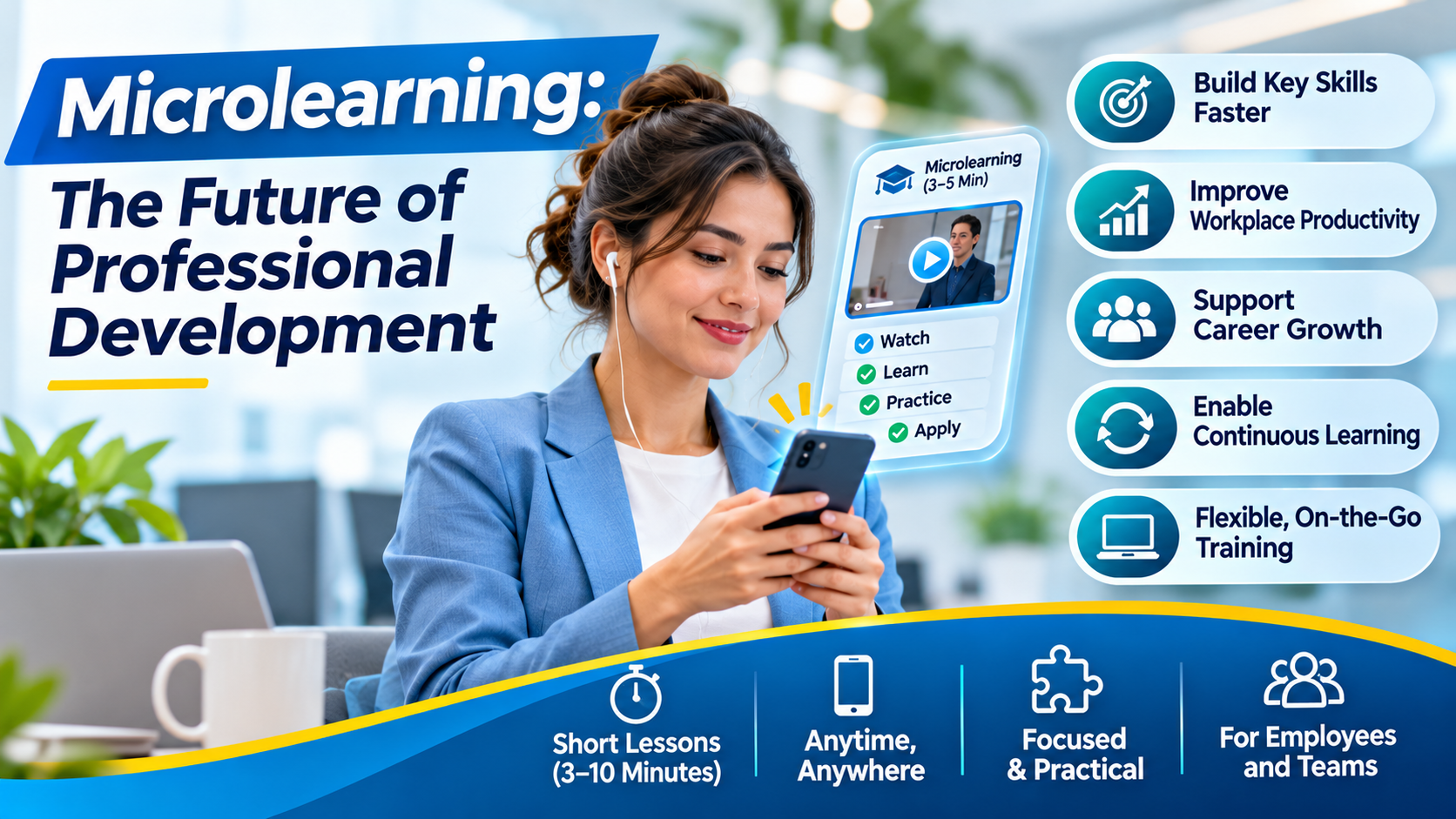
Microlearning is transforming professional development by making workplace learning shorter, more flexible and easier to apply. As businesses face changing skill requirements and employees struggle to balance training with daily responsibilities, bite-sized learning is emerging as a practical approach to improving employee skills, workplace productivity and long-term career growth.
The Changing Face of Professional Development
Professional development has traditionally involved lengthy training sessions, classroom programmes and extensive learning materials. While these methods continue to play an important role, they do not always fit into the busy schedules of modern employees.
Today, professionals are expected to learn new technologies, improve their communication skills and adapt to changing industry demands while managing their everyday responsibilities.
This has encouraged organisations to explore more flexible learning methods. Microlearning offers a different approach by breaking complex subjects into smaller, focused learning sessions that employees can complete within a few minutes.
Instead of spending several hours attending a training programme, employees can learn through short videos, interactive quizzes, practical demonstrations and digital learning modules.
The idea is simple: make learning easier to access and more relevant to everyday work.
How Microlearning Improves Employee Skills
One of the biggest advantages of microlearning is its ability to focus on specific skills and knowledge gaps.
For example, an employee learning a new software system may not need to complete an entire training course. Short tutorials covering individual functions can help them understand the system step by step.
Similarly, sales professionals can learn negotiation techniques, managers can improve leadership skills, and customer service teams can receive short training sessions on handling difficult situations.
This approach allows employees to focus on what they need to learn rather than going through large amounts of information at once.
When supported by regular practice and feedback, these short learning activities can help improve knowledge retention and practical skills.
The Impact on Workplace Productivity
Employee training often requires time away from regular responsibilities. For businesses, this can create scheduling difficulties and affect daily operations.
Microlearning helps address this challenge by allowing employees to complete short training sessions during suitable periods of their working day.
This flexibility can reduce disruption while making continuous learning part of the workplace routine.
For organisations, the benefits may include improved employee engagement, faster knowledge updates and better access to job-related information.
However, productivity improvements depend on the quality of the training and whether employees can apply what they learn to actual workplace tasks.
Digital Platforms Are Making Learning More Accessible
Technology is playing a major role in the growth of microlearning.
Mobile learning applications, online training platforms and learning management systems allow employees to access educational content from different locations and devices.
Businesses can also use digital platforms to monitor learning progress, identify skill gaps and recommend training based on individual roles.
Artificial intelligence is adding another dimension by helping organisations personalise learning experiences. Employees may receive content based on their existing knowledge, career goals and training requirements.
This makes professional development more flexible and helps businesses create learning programmes that better match workforce needs.
Microlearning and Employee Career Growth
Professional development is not only about improving performance in a current job. It is also about preparing employees for future opportunities.
As industries change, workers need to continuously update their technical and professional skills. Microlearning can support this process by providing accessible learning opportunities in areas such as digital literacy, leadership, communication, project management and emerging technologies.
Employees can gradually build their knowledge without having to commit to lengthy training programmes every time they need to learn something new.
For employers, this creates an opportunity to develop internal talent, improve workforce capabilities and support employee retention.
A workplace that encourages continuous learning can also help employees feel more confident about their professional growth.
Why Businesses Are Investing in Microlearning
For businesses, employee development is an investment in long-term performance.
Traditional training programmes can involve considerable expenses related to trainers, travel, learning materials and employee time. Digital microlearning programmes can offer a more flexible way to distribute training across large or geographically dispersed teams.
According to the Association for Talent Development's 2025 research, the use of microlearning in organisations increased by 28 percentage points over eight years. The research also identified reduced learning time and ease of access as important organisational benefits.
Businesses are increasingly using microlearning for technical training, employee onboarding, interpersonal skills and performance support.
However, organisations also need to measure whether training leads to meaningful improvements in employee knowledge and workplace performance.
The Limitations of Microlearning
Despite its advantages, microlearning is not suitable for every learning requirement.
Some subjects require detailed explanations, extended discussions and practical experience. Complex leadership decisions, professional judgement and advanced technical skills cannot always be developed through short digital lessons alone.
There is also a risk that employees may complete learning modules without fully understanding or applying the information.
To make microlearning effective, businesses should combine short lessons with practical exercises, assessments, feedback and opportunities for deeper learning.
The objective should not be to make every training programme shorter, but to make learning more useful and relevant.
Conclusion
Microlearning is changing the way organisations approach professional development by making workplace learning more accessible, flexible and focused on practical needs.
For employees, it creates opportunities to develop new skills, improve confidence and prepare for future career opportunities. For businesses, it offers a way to support workforce development while managing training time and resources more effectively.
As technology continues to reshape industries, continuous learning will become increasingly important. Organisations that make skill development part of everyday working life will be better prepared to respond to new challenges and changing business requirements.
Ultimately, professional growth does not always require hours of training at a time. Sometimes, a few minutes of focused learning, followed by the opportunity to put that knowledge into practice, can make a meaningful difference.