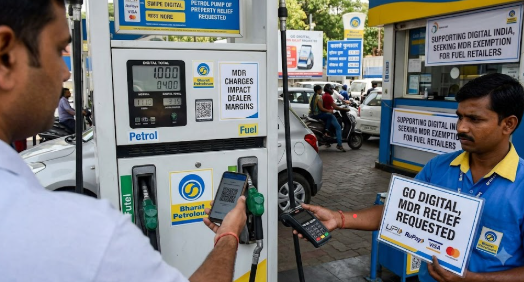
Digital payments have become a routine part of everyday life in India, and buying fuel is no exception. Customers at petrol pumps are increasingly choosing UPI, cards and other cashless options for faster and more convenient payments.
For petroleum dealers, however, the growing use of digital payments has also brought a cost concern. Dealers are seeking an exemption from the Merchant Discount Rate (MDR) on fuel transactions, saying payment-related charges add to the operating expenses of businesses that already work with relatively limited margins.
More customers are choosing cashless payments
The shift towards digital payments has changed the way petrol pumps handle daily transactions. Customers no longer need to depend on cash, while electronic payments can make it easier to keep transaction records and manage collections.
For fuel retailers, digital payments can also reduce the need to handle and store large amounts of cash. But as the number and value of electronic transactions increase, the associated costs have become a growing concern for dealers.
Small charges can add up quickly
An MDR that appears small on an individual transaction can become a significant expense when applied across a large number of payments.
Fuel stations typically handle a high volume of transactions every day. Since dealers operate within a relatively structured margin framework, additional payment costs can have a direct impact on their earnings.
This is particularly relevant for smaller fuel outlets, where there may be less room to absorb rising expenses.
Fuel stations are facing several other costs
Payment charges are only one part of the operating expenses faced by petroleum dealers. Fuel stations also have to manage employee costs, electricity bills, equipment maintenance, security, technology and regulatory requirements.
At the same time, dealers have to maintain their outlets and payment infrastructure so that customers can complete transactions smoothly.
Against this backdrop, dealers argue that reducing or removing MDR on fuel sales could provide some relief without affecting customers' ability to make digital payments.
Convenience for customers remains important
Despite their concerns over transaction costs, fuel dealers are not looking to move away from digital payments. Cashless transactions have become an important part of customer service at petrol pumps.
For consumers, digital payments offer speed and convenience. They can also provide an electronic record of the transaction, which can be useful for individuals as well as businesses managing travel and fuel expenses.
The challenge is to ensure that this convenience does not create an additional financial burden for the merchants providing the service.
Why the issue matters for smaller businesses
The MDR debate is especially relevant to small and independently operated fuel stations.
Large businesses may have greater capacity to absorb changes in operating costs, but smaller dealers often have to manage expenses more carefully. Even a modest increase in the cost of processing payments can become important when multiplied across thousands of transactions.
Relief on MDR could therefore help smaller operators manage their costs while continuing to offer customers multiple payment options.
The digital payment system also needs investment
There is another side to the discussion. Digital payment networks require continuous investment in technology, cybersecurity, fraud prevention, connectivity and infrastructure.
As transaction volumes rise, payment systems need to remain reliable and capable of handling large numbers of transactions securely.
This means any changes to MDR need to consider not only merchant costs but also the financial sustainability of the wider payment ecosystem.
Finding a balance between merchants and payment networks
The demand from petroleum dealers highlights a broader challenge for India's digital economy. Businesses want affordable payment services, while banks and payment companies need adequate resources to maintain and improve the infrastructure behind those transactions.
A sustainable framework would therefore need to balance the interests of consumers, merchants and payment service providers.
For fuel retailers, the immediate concern is keeping transaction costs manageable. For consumers, the priority is maintaining convenient and secure ways to pay. For the digital payments industry, continued investment in infrastructure and security remains essential.
A growing issue as fuel payments go digital
India's transition towards a less-cash economy has created major opportunities for businesses and consumers. Petrol pumps are an important part of that transition because fuel is an essential purchase made by millions of people and businesses.
As digital payments become even more deeply integrated into fuel retail, the question of who bears the cost of processing those transactions is likely to remain an important industry issue.
The petroleum dealers' demand for MDR relief reflects the need to make digital payments commercially sustainable for the businesses that accept them, while preserving the convenience and security that consumers have come to expect.